The Journey from Scotland
From a shoemaker’s household on the Black Isle to plantation society in Jamaica—and a family story that would reach Fiji.
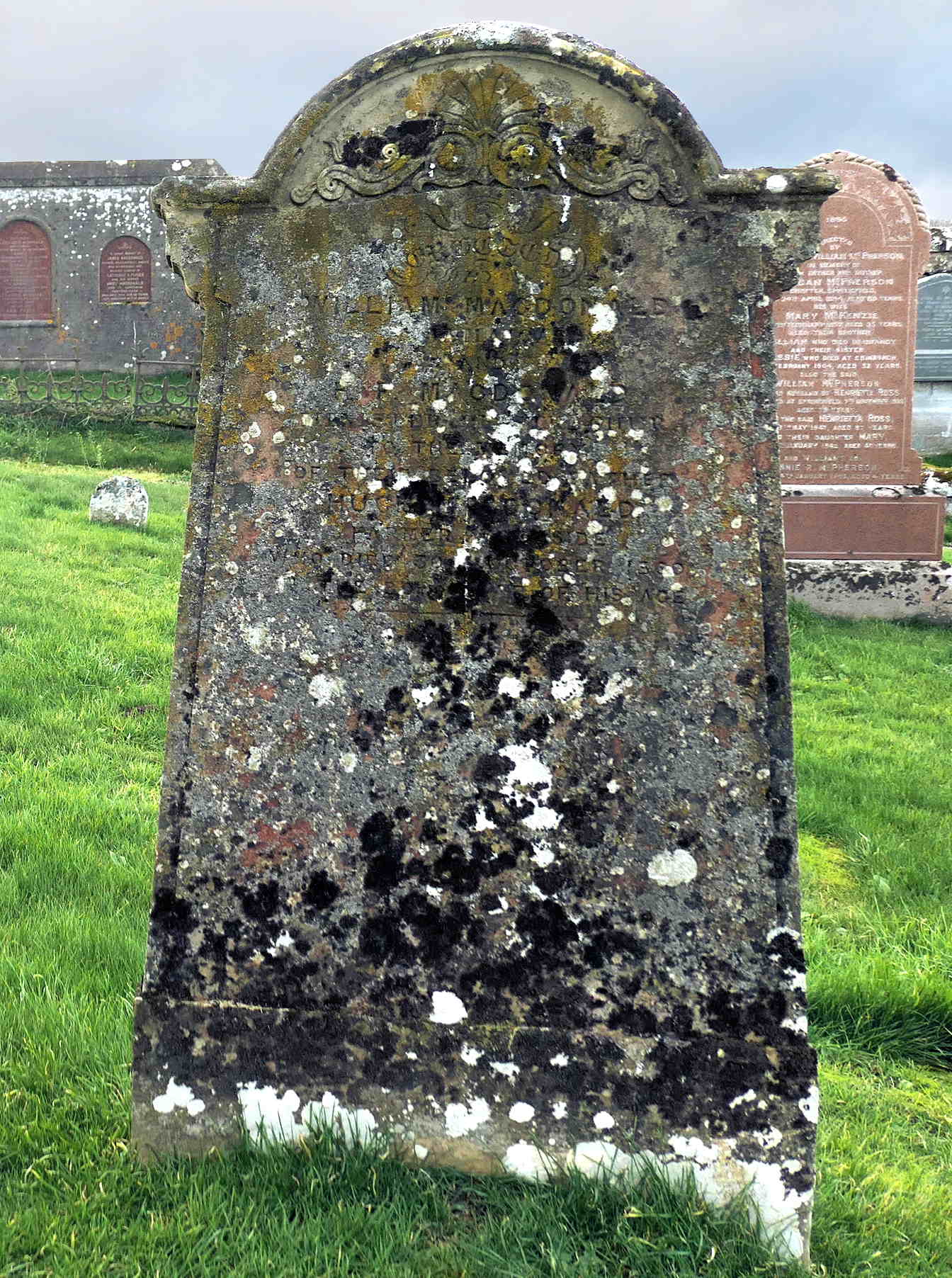 On a family memorial in the burial ground at Cullicudden, on Scotland’s Black Isle, the word "Jamaica" appears beside that of William Macdonald.
The stone commemorates his father, Hugh, a gardener who became a farmer at nearby Woodside; it was erected by William and his brother Hugh Ferguson Macdonald, a minister in Strachur. Within a few lines, a rural Scottish household opens onto a much larger world. [2f]
William’s grandfather, also named William, had been a shoemaker in the parish of Resolis. William himself, born at Braelangwell in 1816, would become a planter and Custos of St Mary in Jamaica.
Between those two lives lay more than an Atlantic crossing: there were changing livelihoods, the ambitions and uncertainties of estate communities, and generations of women whose family ties connected one household to the next.
Our story follows the lives of William Macdonald and his wife Elizabeth, their son Hugh Macdonald and his wife Christian, and then Hugh & Christian's son William Macdonald who left Scotland for Jamaica.
The family at a glance
William Macdonald & Elizabeth Urquhart
William, a shoemaker in Resolis, and Elizabeth were the parents of Hugh Macdonald.
Hugh Macdonald & Christian / Christina Ferguson
Hugh (1781–1860), their son, worked as a gardener and later farmed at Woodside. He and Christian (1794–1864) were the parents of the William born in 1816.
Christian’s Ferguson, Fraser & Munro ancestry
Christian was the daughter of Barrington Ferguson and Henrietta Fraser. Barrington’s parents were John Ferguson and Christian Munro.
William Hugh Macdonald & Anne Olivia Macdonald
William (1816–1885), Hugh and Christian’s son, became a planter and Custos of St Mary, Jamaica. William and Anne were Norman Macdonald’s parents. Their Jamaican family also included Olive and Hugh.
Norman Macdonald & Mary Boehm
Norman married Mary Boehm, daughter of Soli Nataleira. Their marriage carries this branch of the family into Fiji.
The shoemaker William and the Jamaican William were grandfather and grandson. The younger man appears as William in the baptismal record and Jamaican notices, and as William Hugh in later accounts. Macdonald, MacDonald and McDonald are spelling variants found in the records.
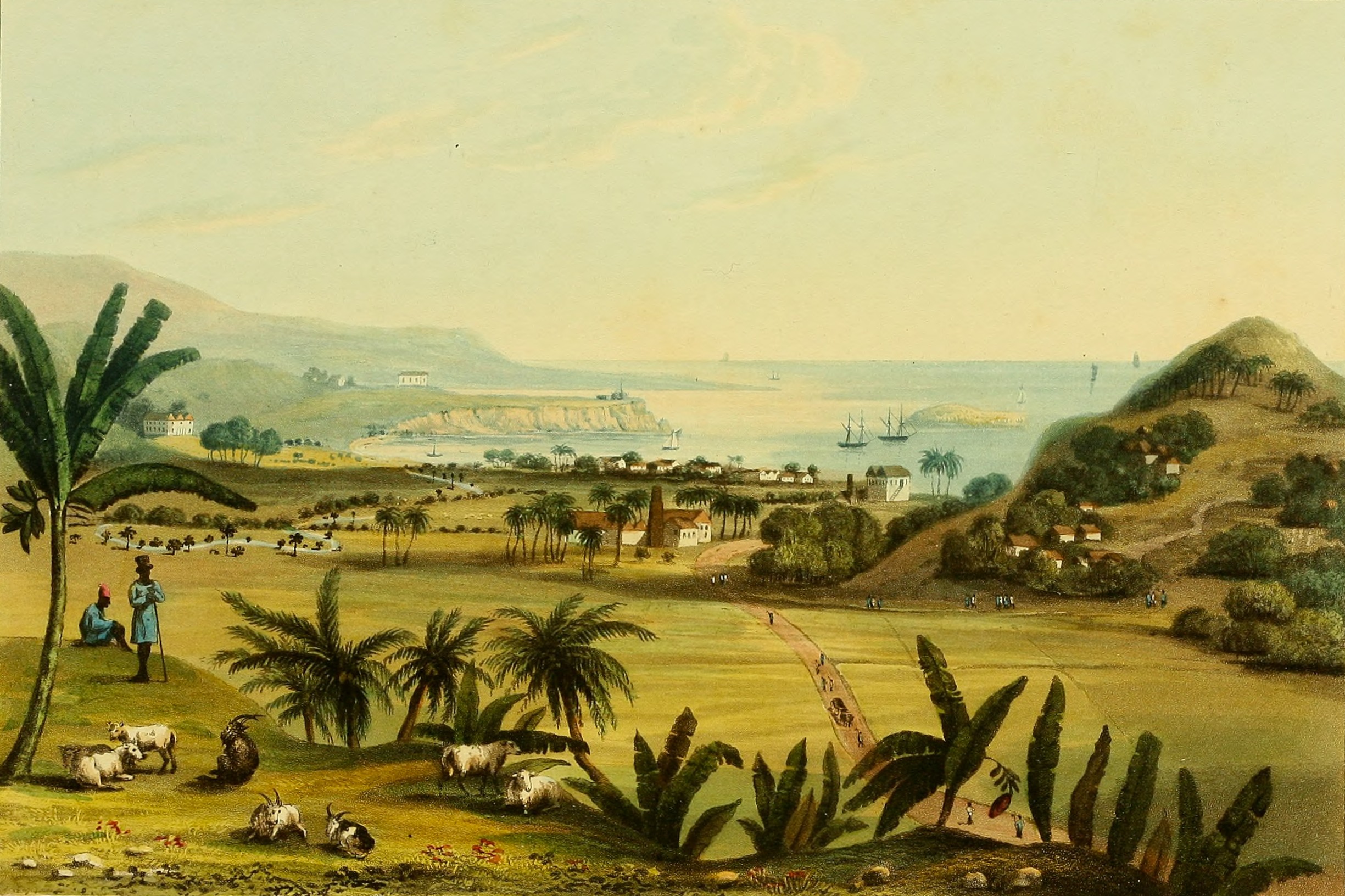
Port Maria, St Mary, in the early 1820s, by James Hakewill. Plate 11 of A Picturesque Tour of the Island of Jamaica, first published in 1825. An early view of the district associated with the family, not a depiction of their home. Public domain; Wikimedia Commons.
A Highland home beside the sea
The Black Isle lies just north of Inverness, between the Cromarty Firth and the Beauly and Moray firths. Despite its name, it is a peninsula, and its settled farmland offers a different picture of the Highlands from the mountains and glens more familiar to visitors. Along its northern side, the parish of Resolis brought together farms, small settlements and estate households, with Cromarty’s harbour near the peninsula’s northeastern tip. [3, 13]
For families living here, land and sea belonged to the same economy. Agricultural work sustained the countryside, while the firths connected it to fishing, coastal shipping and more distant markets. Cromarty’s commercial history reached into the Caribbean: goods left for plantation colonies, and money returned with people who had made their fortunes overseas. Jamaica was far away, but it was not beyond the horizons of this part of Scotland. [4]
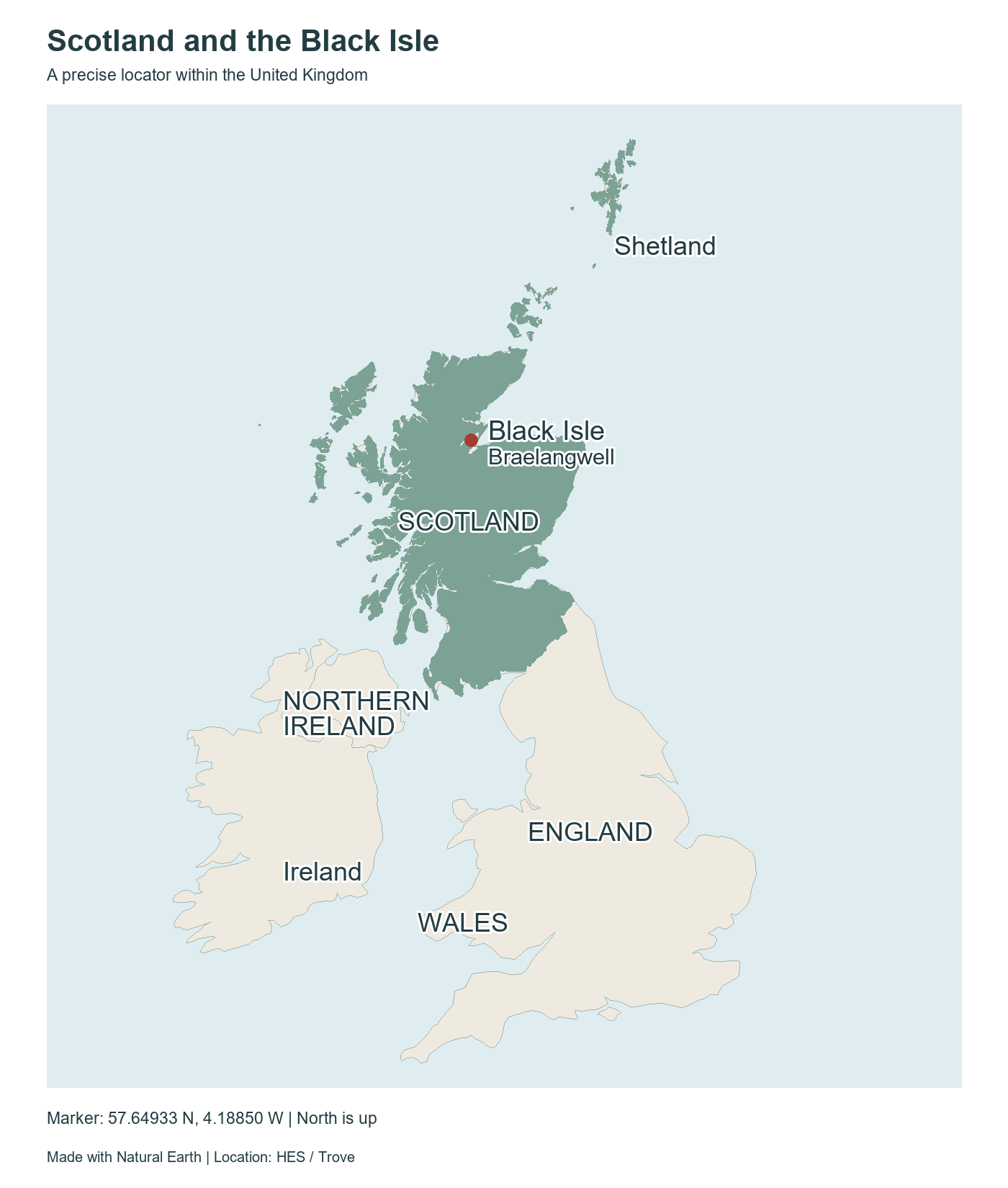
Scotland and the Black Isle. The marker locates Braelangwell at 57.64933° N, 4.18850° W. Natural Earth boundaries; location from Historic Environment Scotland via Trove. Modern geography is shown.
The family’s local world can still be traced through a cluster of names: Culbo, where William and Elizabeth’s household was recorded at Hugh’s baptism; Braelangwell and Poyntzfield, where Hugh worked as a gardener; and Woodside, where he later farmed. Kirkmichael and Cullicudden preserve the district’s older church history, while the church built at Resolis in 1767 belongs to the landscape into which Hugh was born. His memorial stands at Cullicudden, a short distance from many of the places that shaped his life. [1, 3]
These were neighbouring communities rather than isolated points on a pedigree. Work, worship, marriage and the raising of children repeatedly brought families into contact across the same small area. The Macdonalds’ story begins within that network, before one branch acquired the overseas addresses that would make it distinctive.
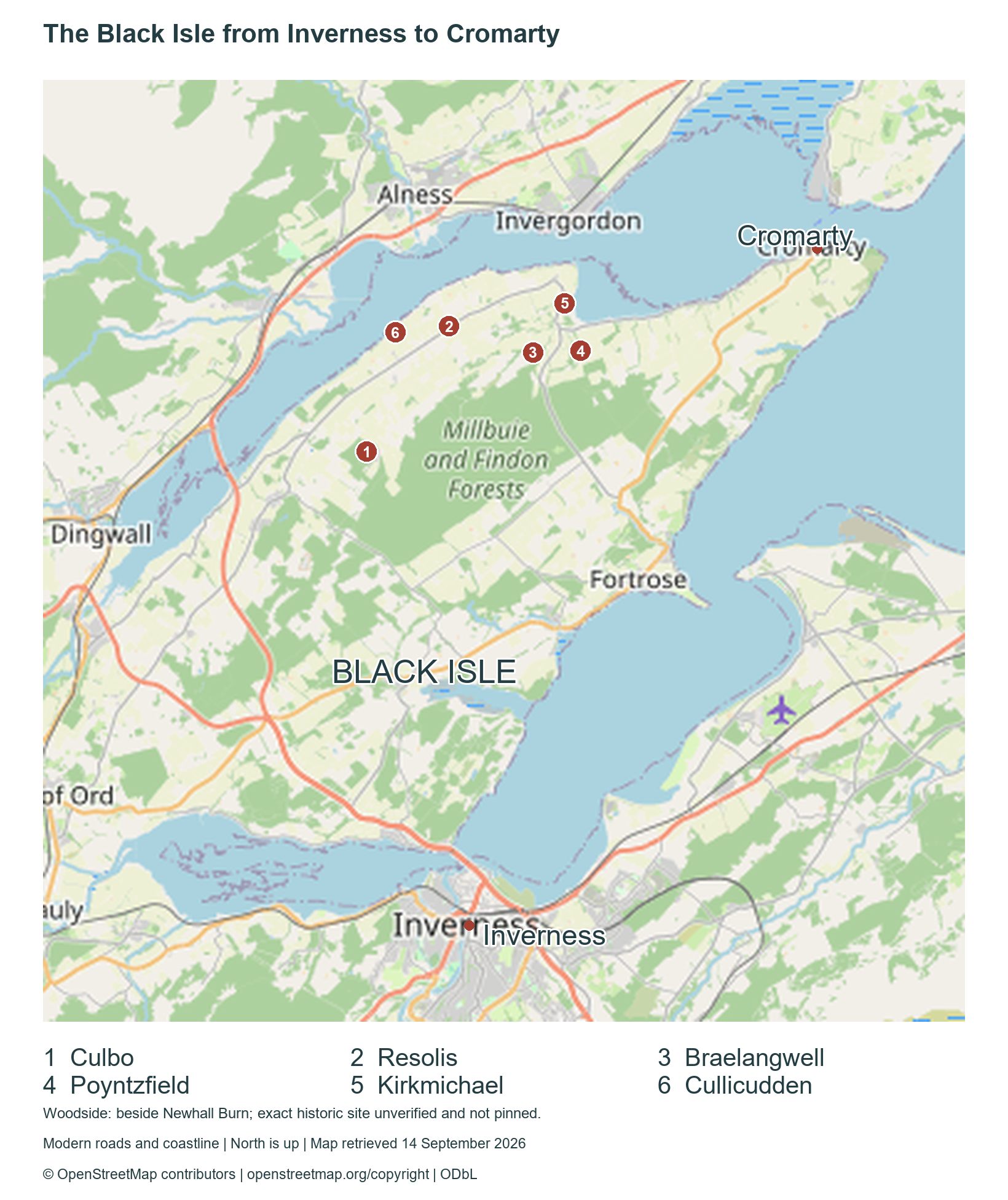
The Black Isle in its wider setting, including Cromarty and Inverness. OpenStreetMap shows real modern coastlines and roads. The numbered local sites are enlarged on the following map.
William and Elizabeth: a household on the move
The Resolis baptism register introduces the family on 14 March 1781, naming Hugh as the child of William McDonald, shoemaker in Culbo, and Elizabeth Urquhart. William’s occupation places him among the district’s skilled working people, serving a practical need in a predominantly agricultural community. Elizabeth’s surname preserves a separate ancestral line, although the register gives her no occupational description. [2a]
Over the next nine years, their growing household appears at three different locations. Jean was recorded at Culbo in 1783; Elisabeth and Janet followed at Brea in 1786 and 1788; by Anne’s baptism in 1790, the family was at Blarikey. William was then described as a servant, suggesting a change in the way he earned his living, though shoemaking may still have formed part of it. These entries follow a family adjusting its place within the local economy, with four daughters joining Hugh as the decade passed. [2a]
Elizabeth appears under several versions of her name—Elizabeth, Elisabeth, Elspat and Lizy—as clerks recorded successive baptisms. The variations belong to the paperwork rather than to a succession of different women. Alongside William’s name and the household’s changing addresses, they allow her to be followed through years in which family life expanded and circumstances shifted.
For Elizabeth, each new address was also the setting in which children were being raised. The register’s spare format reduces years of household life to names and dates, but the sequence reveals something of its demands: five recorded children, a move from Culbo to Brea, and another to Blarikey as William’s occupational description changed.
Hugh’s later career grew out of this mobile working household, shared with sisters whose lives extended beyond the branch followed here.
The Urquhart name had deep local associations, including among landowning families, but Elizabeth’s own parents have not been securely identified. Her place in this history rests on a more immediate foundation: the family she formed with William and the children whose baptisms preserve her name. For their descendants, she is the earliest known woman in this Macdonald line, present at its beginning rather than added as an afterthought.
The women behind Christian Ferguson, Hugh's eventual wife
The family that young Hugh eventually married into had its own long involvement with the farms and estates of Resolis.
Christian Ferguson’s paternal grandparents, John Ferguson and Christian Munro, were recorded at Ardoch, an earlier name associated with Poyntzfield. John was described as a servant. Their children included Adam, John, Margret and Ann, followed in 1761 by twins, Barington and Jean. Barington, later also called Barry or Barrington, became Christian Ferguson’s father. [1, 2b]
Christian Munro’s granddaughter would carry the same given name into the Macdonald family. The connection is supported by the register entries linking the generations; it also gives a sense of the maternal names carried forward as children established households of their own. Through Christian Ferguson, the descendants of Hugh Macdonald inherited Munro ancestry as well as the surname that dominates the later story.
Barrington married Henrietta Fraser, whose name was often shortened to Henny or Heny in the children’s entries. Their household can be followed from the Birks to Woodhead and Brea. Mary and David were born before Christian, who was baptised on 16 July 1794 at Woodhead; another Henrietta and a son, John, followed. Across those entries, Henrietta Fraser emerges as the mother of a family growing up among the working farms of the district. [2b]
That setting offered neither complete stability nor a simple progression towards prosperity. A removal action in 1791 named Barry and John Ferguson among tenants at Wester Birks. Jim Mackay’s examination of the surviving papers suggests that Barry was not removed through that particular action, but the proceedings show how exposed a tenant household could be to decisions over its land and home. [1]
The Reverend Donald Sage later recalled Barrington as a man who had once farmed substantially at Brae before his circumstances declined. Barrington’s religious commitment earned Sage’s admiration, even if the minister was less generous about his abilities as a speaker. It is a portrait coloured by the observer’s own judgements, yet it brings into view a familiar tension in rural life: standing within the church did not ensure lasting financial security. [2c]
Henrietta had died by August 1830, when the kirk session described Barrington as a widower. By then their daughter Christian was raising her own large family with Hugh Macdonald. Behind her stood two women whose lives had been closely bound to this countryside: Christian Munro at Ardoch and Henrietta Fraser at the Birks, Woodhead and Brea. Their documented ancestry ends here; the surnames alone do not connect them to the prominent Munro or Fraser pedigrees of Highland history.
A gardener’s family
Hugh Macdonald and Christian Ferguson had begun married life by April 1814, when their first recorded child, Henrietta, was baptised. Hugh was working as a gardener at Braelangwell, and their daughter carried the name of Christian’s mother.
Two years later, on 8 March 1816, William was born there, followed by his baptism on 14 March. The future Jamaican planter began life in the household of an estate employee. [2d]
Gardening at a country house combined practical work with the maintenance of its cultivated setting. Hugh’s occupation placed him within the life of the estate, although Braelangwell’s grand house should not be mistaken for the family’s own home. The baptism record identifies the estate setting; it does not locate their cottage. The house visible today also incorporates later alterations, so it offers a connection to their surroundings rather than an unchanged scene from William’s childhood. [3]
As the children arrived, the family’s addresses followed Hugh’s work. A second son, Hugh, was born in 1818, and David in 1820, when the register placed them at Agnus’ Hill, usually discussed as Agneshill. By Elizabeth’s birth in 1823 they were associated with Poyntzfield. Christian followed in 1825, Jamima Graham in 1828 and Jane in 1831. Seventeen years separated the first and last of these eight recorded children. [2d]
Christian’s adult life was therefore spent raising a substantial family across several stages of Hugh’s employment. The familiar names carried relationships into the next generation: Henrietta recalled her mother, while Christian linked daughter, mother and grandmother. William’s departure would eventually take one of these children across the Atlantic, but his five sisters and two brothers belonged equally to the household from which he left.
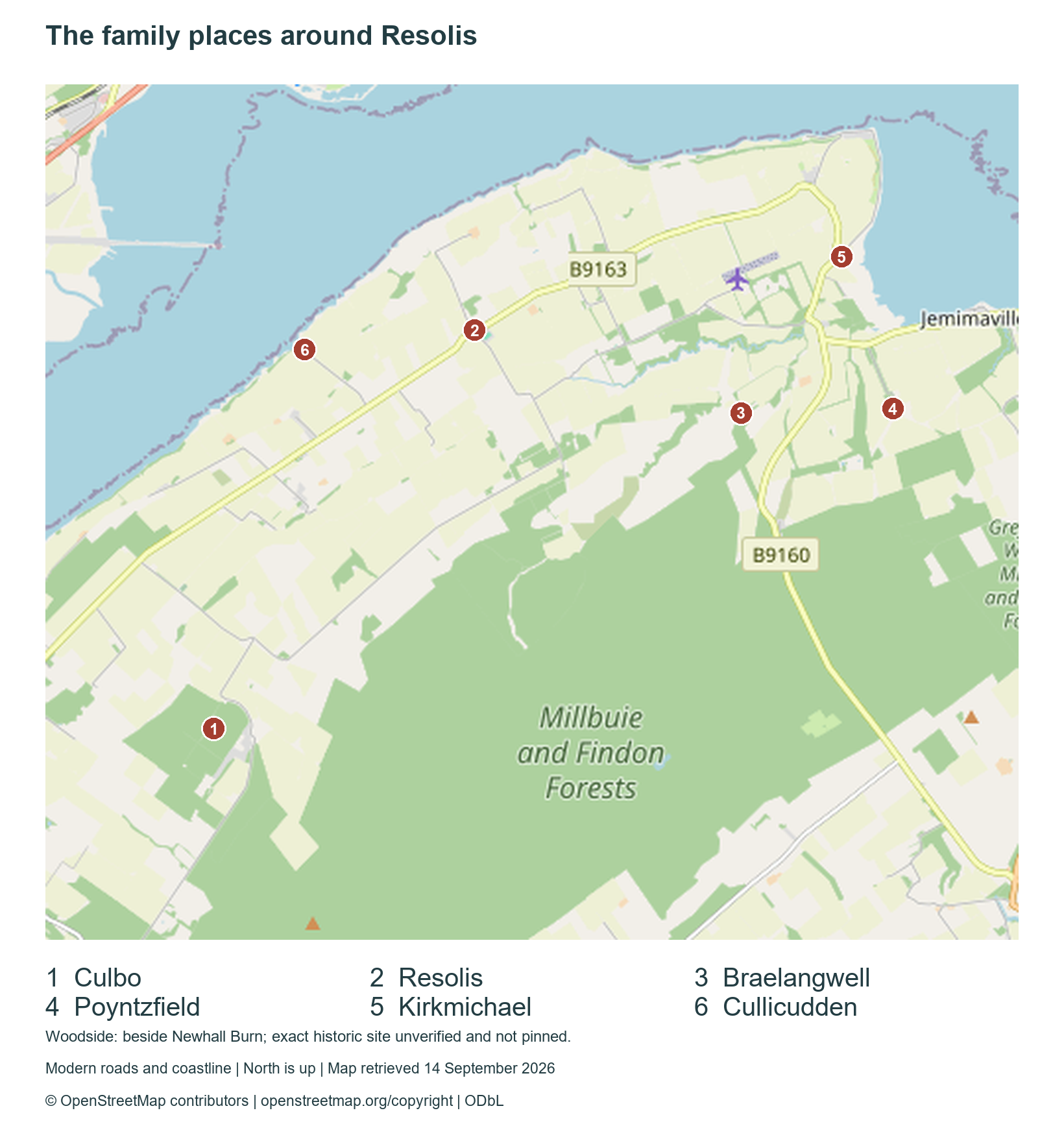
The family district in Resolis. Verified modern reference points identify Culbo, Braelangwell, Poyntzfield, Resolis, Cullicudden and Kirkmichael. Woodside is described in the source as beside Newhall Burn; its precise historical farm site is not pinned. OpenStreetMap base map, with Trove and OSM location references.
A rare account of Christian speaking for herself survives from November 1834. Called before the Resolis kirk session during an inquiry into a rumoured relationship, she was asked about a visiting captain and the wife of the estate’s grieve, or farm overseer. Christian said she had seen them talking, but had witnessed no improper behaviour. She had nevertheless warned the woman that frequent conversations with the captain were encouraging suspicion. [2e]
Her evidence offers a glimpse of judgement exercised under the pressures of a closely observed community. She understood the force of gossip and the damage it could do to a woman’s reputation, yet distinguished what she had actually seen from what others were prepared to infer. The church clerk preserved her statement in the language of an inquiry, but beneath that formal setting is a neighbour trying to navigate the distance between conversation, rumour and accusation.
Christian’s father, Barrington, was himself a church elder. The episode thus brings together the two sides of her local world: the authority of the institution in which her father served, and the informal relationships among women living within the estate community. It is a fuller glimpse of her than the baptism registers can provide, revealing someone capable of cautioning a neighbour without endorsing the allegation against her.
Those who stayed
Hugh eventually left gardening for farming at Woodside on the Newhall estate. Long after his death, a newspaper remembrance still recalled both phases of his working life. He died on 30 October 1860, in his eightieth year, and the memorial erected by his sons at Cullicudden linked the farmer at Woodside to a minister in Argyll and a son established in Jamaica. [2f]
Christian survived him by several years; the published family reconstruction records her death in 1864, aged about seventy. Her children’s lives had spread well beyond the household she and Hugh formed at Braelangwell, although several remained rooted in Scotland. The younger Hugh became a schoolmaster and minister, marrying Christina McIver in 1846 and pursuing a clerical career that gave the family another route into professional life. [1, 2g]
Two daughters, Christina and Jemima, each married a man named Donald Ross. These were separate households, associated with Poyntzfield and Newmills respectively. Their memorials record Christina’s death in 1902 and Jemima’s in 1907, carrying the Scottish side of the family into a new century. William’s departure and his later prominence in Jamaica were only part of the generation’s story. [2g]
At Cullicudden, those local lives remain close to the memorial bearing the Jamaican connection. The contrast is striking without requiring a clean break between those who left and those who stayed: William continued to be named as Hugh’s son, sharing responsibility for the stone with his brother. Whatever distance separated their daily lives, the inscription placed them together within the family they came from.
Across the Atlantic
For a young man raised near Cromarty, overseas opportunity had a recognisable geography. The port’s trade connected the Black Isle to a wider commercial world, including the Caribbean colonies. Estate employment could also place working families within reach of people whose interests extended abroad. Mackay suggests that the Jamaican connections of the Gun Munros of Poyntzfield may have helped William, although the circumstances of his departure have not been recovered. [1, 4]
His exact ship, sailing date and port of embarkation remain unknown. Cromarty offers a starting point for understanding the journey from his home district, but he may have joined an ocean-going vessel elsewhere in Britain after a coastal passage. From whichever port he sailed, the crossing would have placed him within a maritime trade in which passengers travelled alongside cargo and a ship’s progress depended on wind, weather and seamanship.
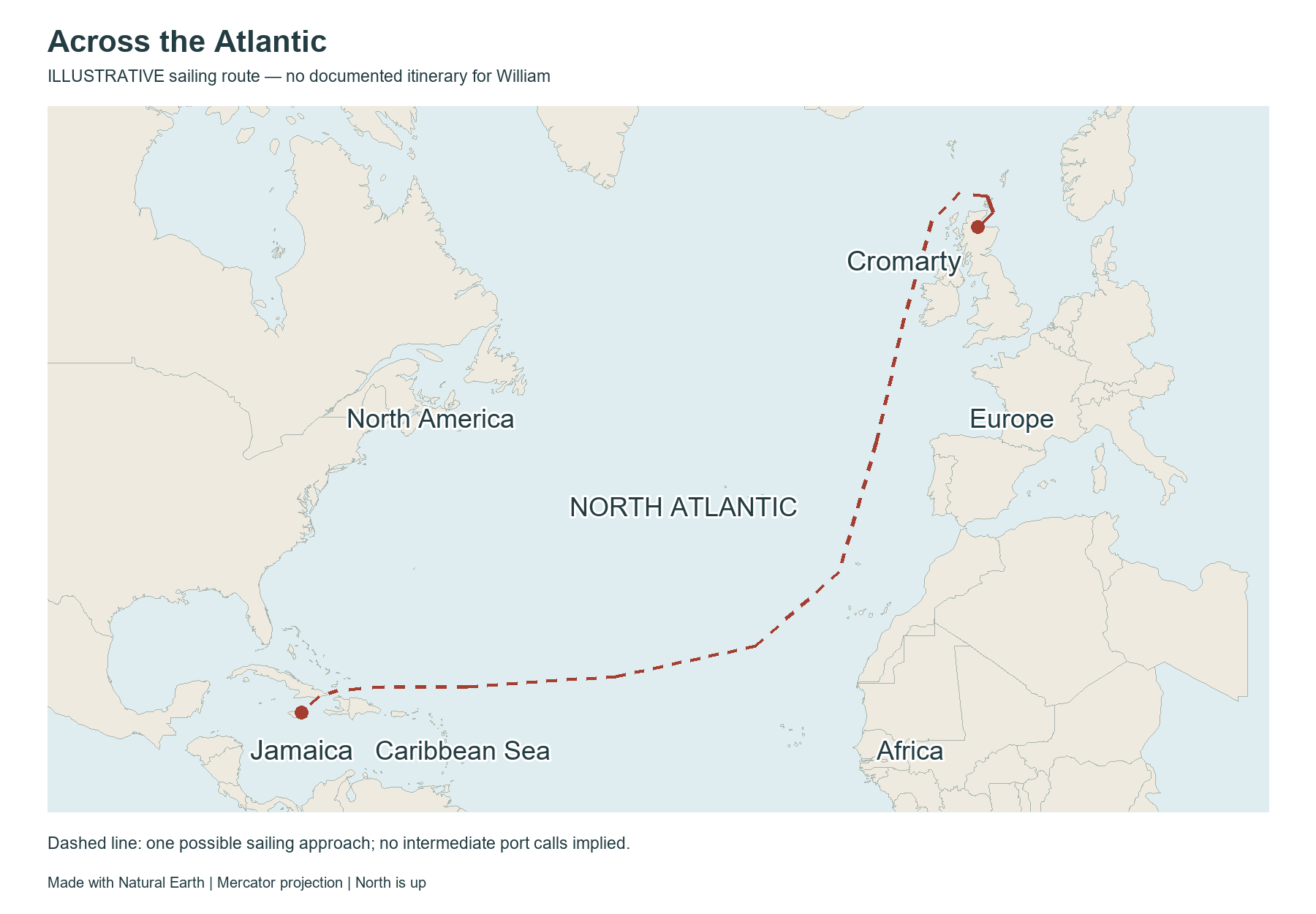
An illustrative Scotland-to-Jamaica sailing route over real Natural Earth geography. Cromarty is a starting reference for the family district, not a documented embarkation port. No ship, departure date, intermediate calls, landing port or exact course is known for William.
Joseph Walter’s 1838 painting of the West Indiaman Britannia captures that world. Built for commercial service and engaged in the Bristol–Barbados trade, the vessel is shown under sail, with passengers visible on deck according to the museum catalogue. The painting presents three views of the same ship, allowing its rig and hull to be seen from different angles. Britannia was not William’s documented vessel, but it is a contemporary example of the ships carrying people and goods between Britain and the Caribbean. [5]
On the outward passage, the westward trade winds at lower latitudes offered a means of crossing the Atlantic. Reaching them could require a course that looks indirect on a modern map, and the route taken would respond to conditions at sea. The illustrative line accompanying this account suggests the scale and broad sailing logic of the journey rather than the track of a particular voyage. [5, 13]
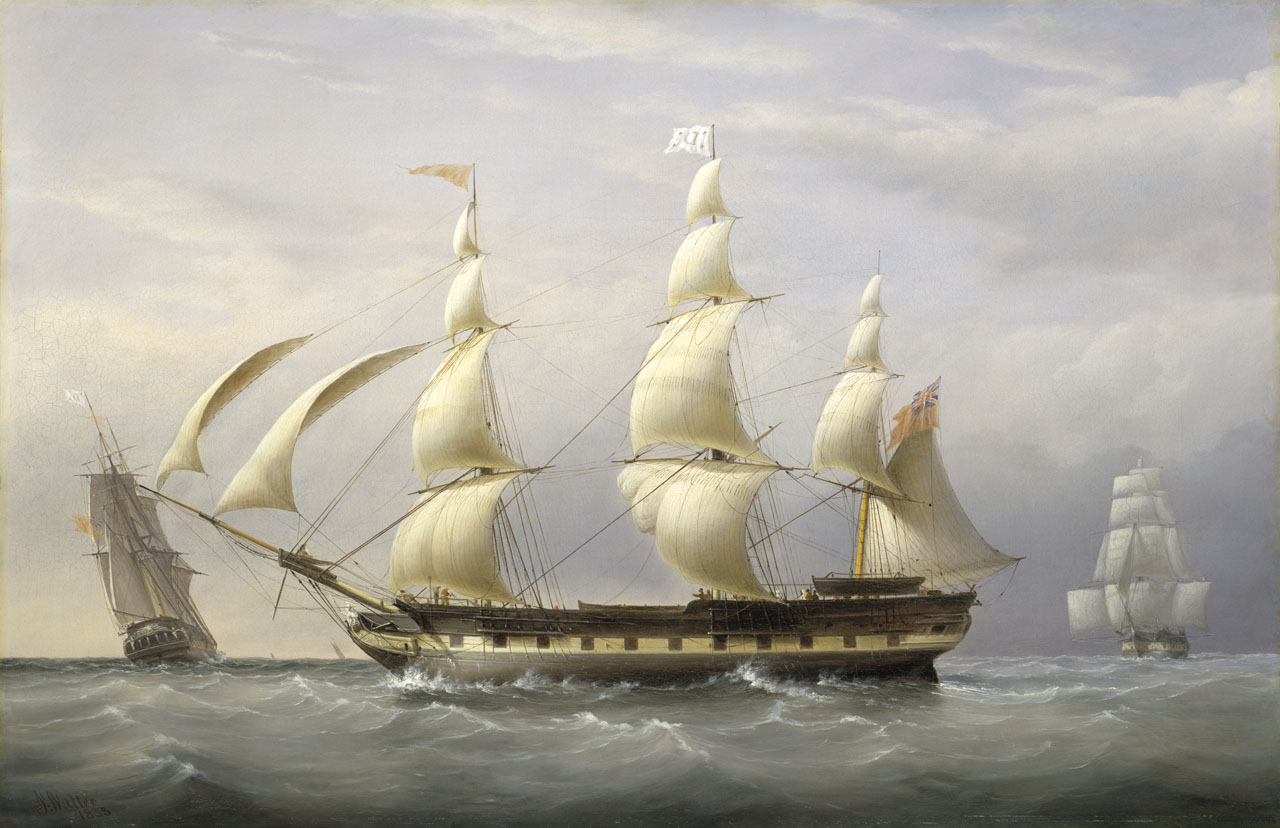
Joseph Walter, The West Indiaman Britannia, 1838. The same vessel appears in three views. A Bristol–Barbados merchant ship, shown here as context for Britain–Caribbean travel; not William's documented vessel. National Maritime Museum, Greenwich, London, BHC2351. Public-domain reproduction via Wikimedia Commons.
For William, the greater change lay at the other end. He left a family whose recorded occupations were shoemaking, service, gardening and farming, and entered a colony where land, commerce and public authority were closely connected. His later position is well documented; the years in which he first found employment, acquired property and established himself are much less visible.
Jamaica after emancipation
William’s Jamaican life unfolded within a society undergoing profound change. The island’s plantation economy had been built on the exploitation of enslaved Africans and their descendants, and emancipation did not erase the unequal distribution of land and power. For an incoming European who eventually entered the planter class, opportunity existed within a social order shaped by that history. [6, 7]
Britain prohibited its transatlantic slave trade in 1807, before William was born. The Slavery Abolition Act of 1833 took effect in Jamaica on 1 August 1834, when he was eighteen, but most of the formerly enslaved were compelled to continue working under the apprenticeship system until full freedom on 1 August 1838. The records used here establish William’s later position as a planter and public official, without establishing personal involvement in slave trading, slave ownership or compensation claims. His arrival date is not yet known. [6]
For Jamaica’s Black population, freedom had been fought for as well as legislated. Sam Sharpe and the rebellion of 1831–1832 belonged to that struggle; after emancipation, the pursuit of land, education and independent livelihoods continued. The aspirations of freed people and their descendants often brought them into tension with estate owners’ expectations of labour and authority. This was the society in which William and Anne made their home, and in which their children grew up. [7]
The surviving images offer glimpses of its public life. James Hakewill’s early view of Port Maria records the coastal setting before the main notices of William’s career, while Isaac Mendes Belisario’s Kingston lithograph shows a costumed performer and spectators during the apprenticeship years. These are places and people seen through the choices of contemporary artists, rather than illustrations of the Macdonald household. [9]
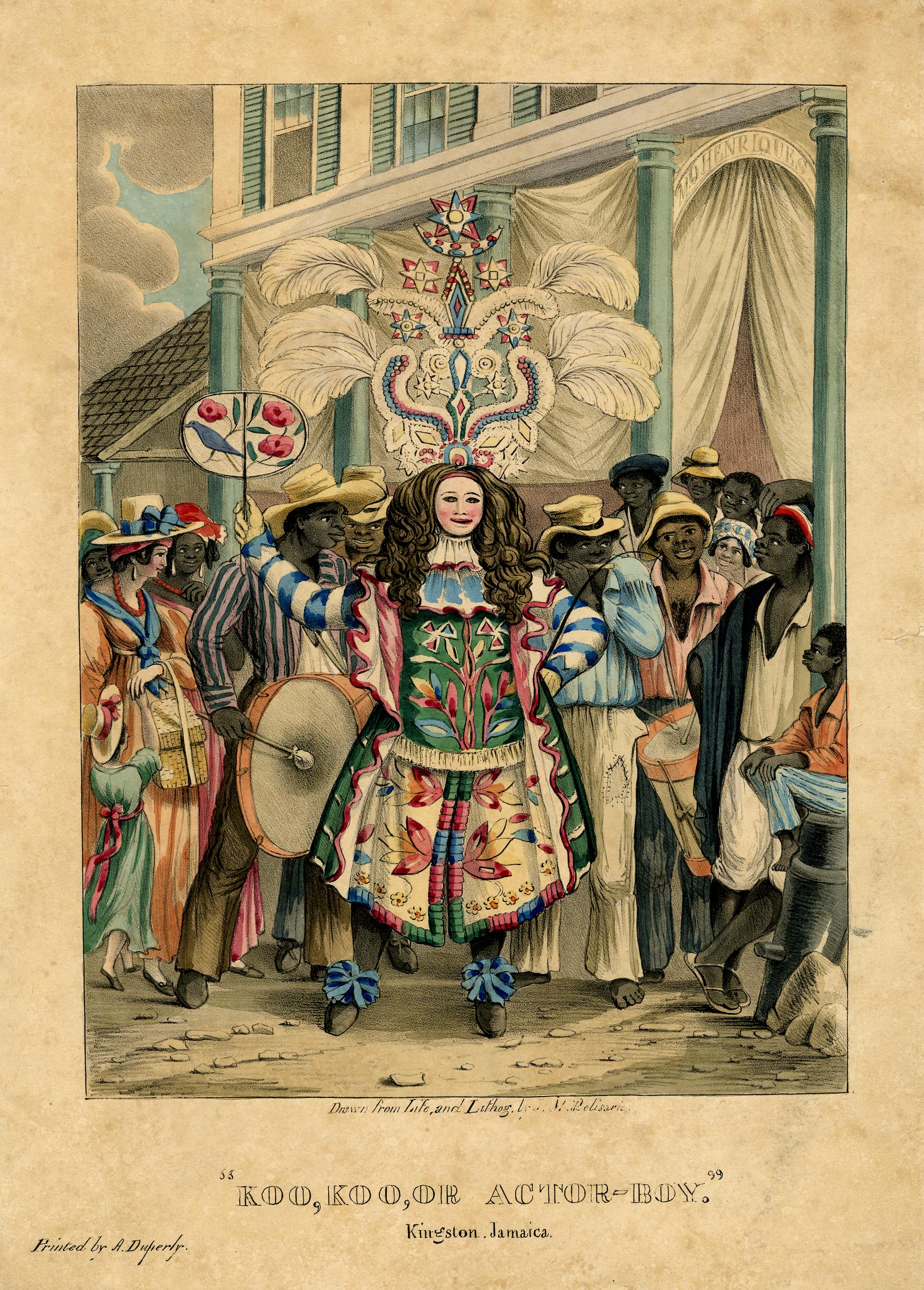
Isaac Mendes Belisario, Koo Koo or Actor Boy, 1837–1838, published by Adolphe Duperly. Hand-coloured lithograph of a costumed performer and spectators in Kingston. British Museum, 2006,0929.48; public-domain reproduction via Wikimedia Commons. Contextual Jamaican life during apprenticeship, not a family portrait.
William of Water Valley
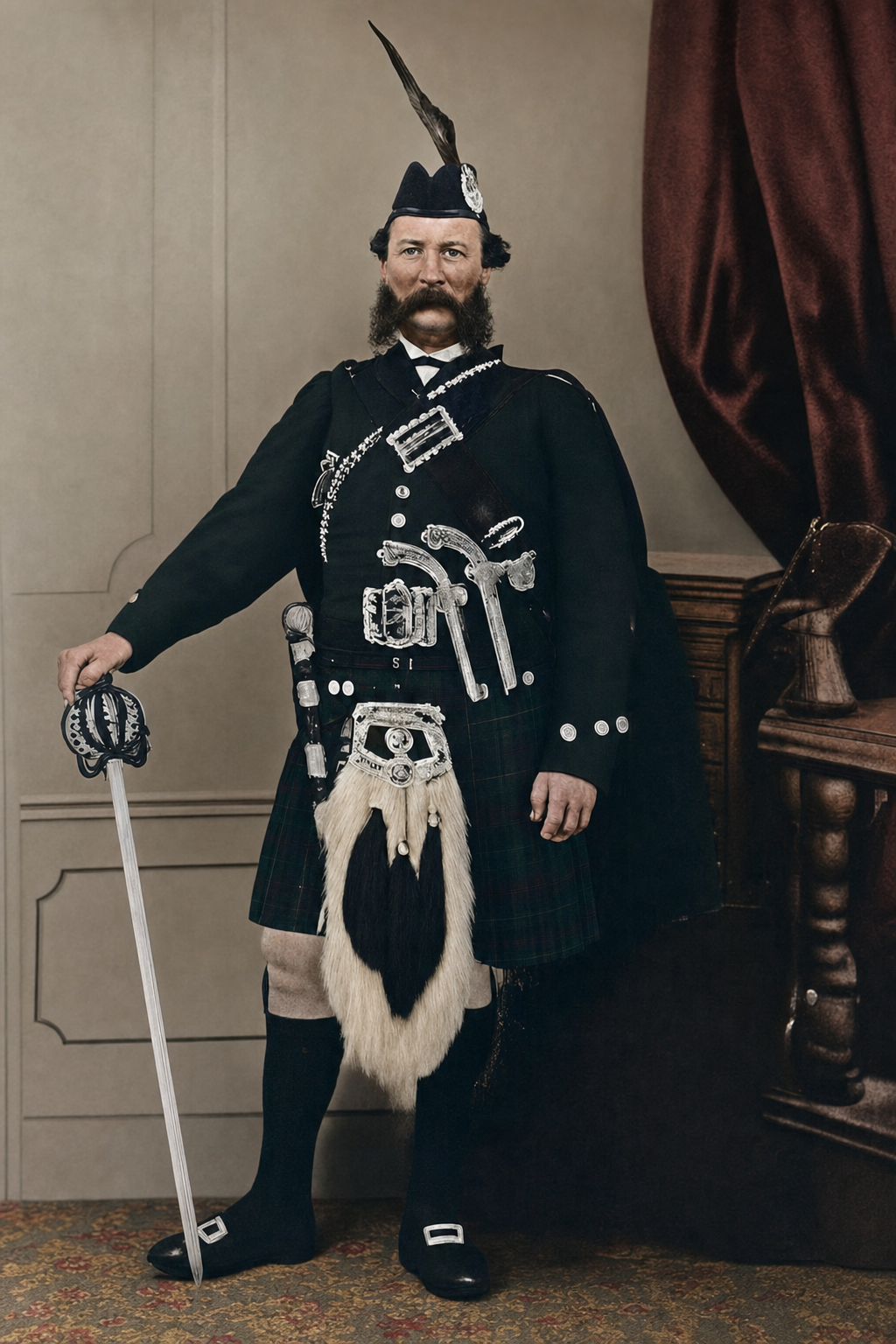 By the later nineteenth century, William was associated with Water Valley in St Mary, on Jamaica’s northern coast. In April 1871, the Daily Gleaner reported his appointment as keeper of the parish’s peace records and chairman of its municipal and road boards. The title by which he became known, Custos, derives from Custos Rotulorum, “keeper of the rolls”, and marked a leading place in parish administration and the magistracy. [2h, 8]
It was a considerable change in standing across three generations. The grandson of a Resolis shoemaker now held public authority in a Jamaican parish, his name appearing in notices of appointments and civic meetings. That rise belonged to the institutions of a British colony, where the position of a planter carried influence well beyond the boundaries of an estate.
St Mary was the parish that framed this part of the family’s life. Port Maria, its capital, was a centre of public business and later the setting for a family wedding. Annotto Bay appears in Anne’s postal address, while Water Valley is named as the estate and residence. Together they locate the family within the northern coastal district, even though the precise site of their house has not been established. [2h, 2i, 2j]
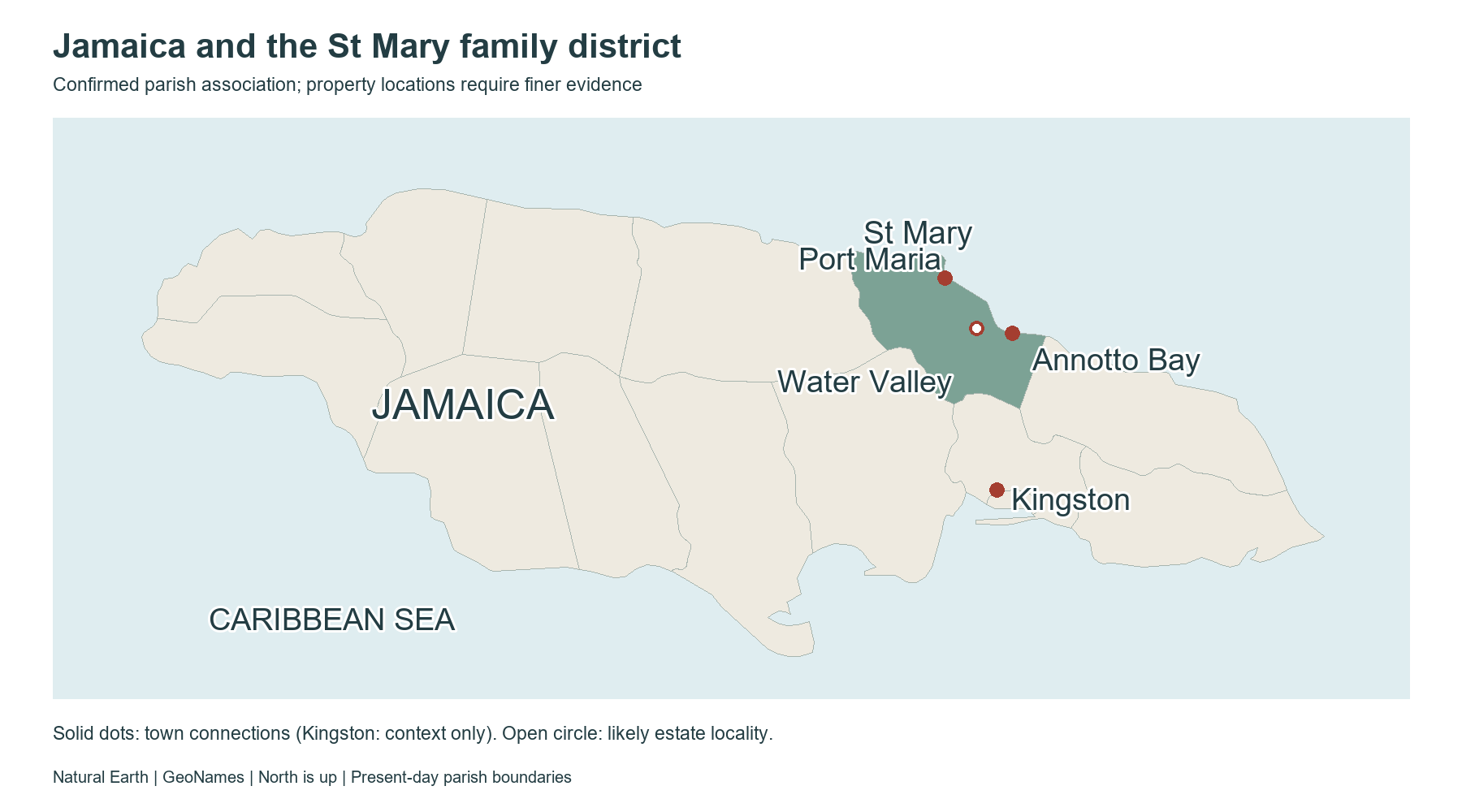
Jamaica and the St Mary family district. Shading marks the confirmed parish association; solid dots mark documented town connections. The open circle marks modern Water Valley as a likely locality match, not a verified house site. Natural Earth boundaries and GeoNames place data. Modern parish boundaries are shown.
An independent Jamaican probate index adds Moore Hall Penn, Water Valley Estate, Metcalfe and St Mary to William Macdonald’s entry in 1886. The combination is consistent with the family’s known connections and provides a lead to the original will, which could give a fuller account of his property and beneficiaries. [10]
William’s public outlook comes briefly into focus at an educational meeting held in Port Maria in 1883. Chairing the gathering, he advocated education for children and linked it to labour and what the report called civilisation. The speech reflects both a concern with schooling and the paternal assumptions of a colonial elite accustomed to deciding how the wider population should progress. His civic role brought those attitudes into public view. [2h]
He died on 14 December 1885. The journey from Braelangwell to Water Valley had taken him from an estate gardener’s household to the ranks of Jamaica’s parish leadership. Yet the family’s next appearances in the newspaper would centre on Anne, first in the business of settling his affairs and later at their daughter’s wedding.
Anne Olivia takes her place
On 29 June 1886, the Daily Gleaner directed creditors and others with claims against William’s estate to Mrs Anne Olivia MacDonald at Water Valley, Annotto Bay Post Office. She was named as the qualified executrix of his will, responsible for administering the estate and dealing with claims against it. In the formal language of the notice, Anne emerges as the person through whom its unfinished business would be conducted. [2i]
The responsibilities attached to that role place her at the centre of the family after William’s death. The notice cannot reconstruct her earlier married life, or tell us how much assistance she had in managing the estate’s affairs, but it identifies a woman entrusted with a consequential task. The home at Water Valley was now also the address to which questions of debt, property and inheritance were directed.
Her securely recorded name is Anne Olivia. Later family compilations identify her as Anna Olivia Cocking, but the proposed maiden surname and accompanying dates still need confirmation from original records. For now, the newspaper provides the clearest contemporary identification of the woman who outlived William and remained prominent in the household. [11]
 Five years later, she appears in a very different setting. On 9 July 1891, Olive, the youngest daughter of the late Custos, married Henry McCrea, a police inspector in St Mary. Her brother Hugh escorted her into the parish church at Port Maria, and Mrs MacDonald gave her daughter away. The guests afterwards gathered at her residence. [2j]
The account brings mother, daughter and son into the same scene. Anne occupied the central parental role at a family wedding; Olive was beginning a household of her own within the parish’s professional and social world; Hugh’s presence linked the occasion to the wider group of siblings. The newspaper was reporting a socially prominent marriage, but its details preserve something more intimate than an official appointment or probate notice: the family assembling around one of its own.
The residence is transcribed as Mosic Hall, a name whose precise identification remains unresolved. What is clear is that Anne continued to have a home at the centre of family gatherings after William’s death. Her story extends beyond the years in which he held office, into the responsibilities and relationships of the next generation.
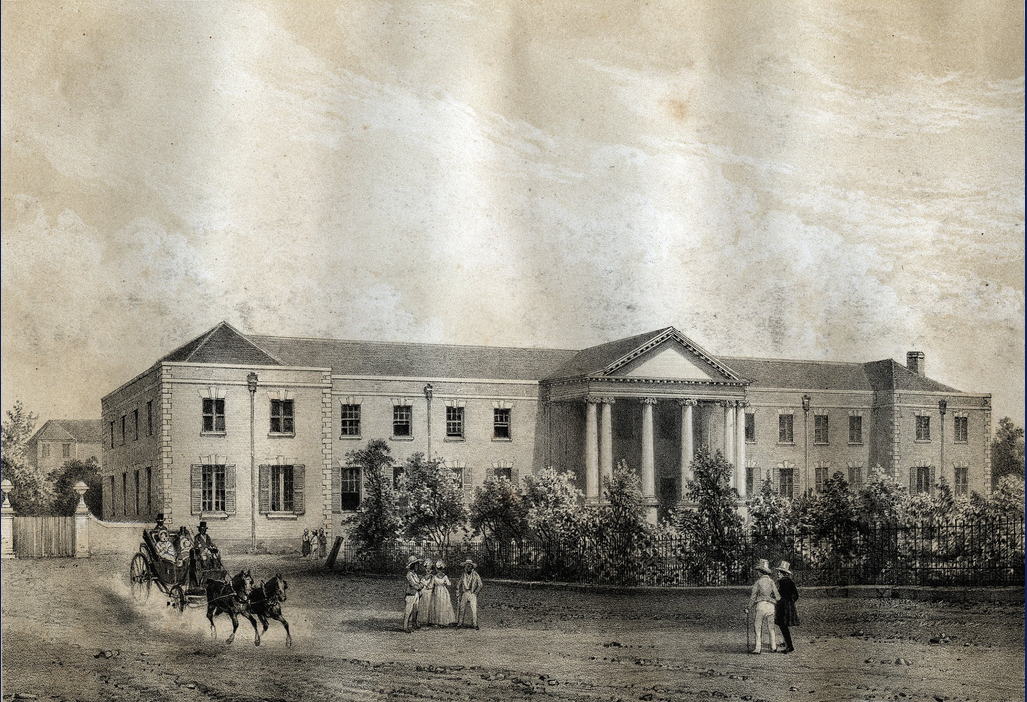
King’s House, Spanish Town, from Adolphe Duperly’s Daguerian Excursions in Jamaica, circa 1840s. A view of colonial civic life elsewhere on the island; no family residence here is implied. Public-domain reproduction via Wikimedia Commons.
A further shore
The family’s continuation into Fiji runs through Norman Macdonald, the son of William and Anne Olivia Macdonald, and his marriage to Mary Boehm. Mary was the daughter of Soli Nataleira. Through their marriage, the Scottish and Jamaican branch became connected to a Fijian maternal history that belongs equally to their descendants. [12]
For families carrying that inheritance today, the route back to Resolis passes through Mary as surely as it passes through Norman. Soli’s place in the ancestry is not a footnote to a traveller’s arrival: her daughter’s family is the point at which these histories meet. The Macdonald surname follows one line through that meeting, while the wider family includes people whose names, homes and affiliations have taken many other forms.
Norman and Mary’s marriage gives the Scottish story its Pacific continuation. Behind him lie William and Anne in Jamaica; behind William, the gardener Hugh and Christian Ferguson; and behind them, the households of Elizabeth Urquhart, Henrietta Fraser and Christian Munro, alongside the men whose names recur in the parish registers.
At Cullicudden, the inscription still holds one part of that geography together: Hugh at Woodside, his minister son in Strachur, and William in Jamaica. The later connection to Mary and Soli carries the story beyond the places named on the stone. What began among a few neighbouring farms on the Black Isle became an inheritance shared across oceans, with each marriage and each generation adding another place—and another family—to the journey.
Sources and Notes
How to read the evidence
The numbered references distinguish contemporary records from later interpretation. The Scottish registers, kirk-session material, memorial inscriptions and newspaper reports listed under reference 2 were consulted through Dr Jim Mackay's transcriptions, not through independently inspected original pages. Those transcriptions are valuable evidence, but an original image should be checked before treating a disputed spelling or date as settled. Historical context describes the surrounding society; it is not a claim that every general practice occurred in this household. Sources were accessed on 14 September 2026.
1. Jim Mackay, Murray Macdonald MP and other distinguished descendants of Hugh Macdonald gardener Poyntzfield and farmer Woodside, Kirkmichael Trust, Story behind the Stone. Key local reconstruction, including family links, Woodside's association with Newhall Burn, Christian's life dates, the 1791 removal proceedings and the proposed Gun Munro connection. The main text here relies chiefly on the dated primary material reproduced on the page. kirkmichael.info
2. Contemporary sources reproduced in Mackay's article, grouped below for traceability. Dates identify the records to pursue in the original collections. They are separately identified because a later author's interpretation and a transcribed historical entry do not have the same evidential status.
2a. Resolis baptism register: Hugh, 14 March 1781; Jean, 20 April 1783; Elisabeth, 12 November 1786; Janet, 3 March 1788; Anne, 12 April 1790. Parents William McDonald and Elizabeth Urquhart under variant spellings. The 1781 date is a baptism date, not an independently established birthday.
2b. Resolis baptism register: John Ferguson and Christian Munro's children, 1751–1761; Barrington Ferguson and Henrietta Fraser's children, 1786–1803. Christian Ferguson's entry is dated 16 July 1794. The supported maternal ancestry stops with the parents named in these entries; no earlier Munro or Fraser pedigree is asserted.
2c. Donald Sage, Memorabilia Domestica, published 1889, recollections of Barrington Ferguson, quoted by Mackay; Resolis kirk-session record, 25 August 1830, describing Barrington as a widower. Sage is an interested contemporary observer whose evaluations are not adopted as objective measures of character.
2d. Resolis baptism register: Henrietta, 19 April 1814; William, 14 March 1816, born 8 March; Hugh, 8 April 1818, born 3 April; David, 17 June 1820, born 13 June; Elizabeth, 16 May 1823, born 10 May; Christian, 6 July 1825, born 3 July; Jamima Graham, 18 September 1828, born 12 September; Jane, 7 July 1831, born 3 July. Parents Hugh McDonald, gardener, and Christian Ferguson. Residence entries trace Braelangwell, Agnus' Hill and Poyntzfield.
2e. Resolis kirk-session minutes, 15 November 1834: evidence of Christy Ferguson, wife of Hugh McDonald, gardener at Poyntzfield. The account of her statement is paraphrased in the narrative. It distinguishes her observations from the circulating allegation; no allegation is presented as a proven affair.
2f. Cullicudden memorial to Hugh Macdonald, died 30 October 1860, erected by William Macdonald in Jamaica and HF Macdonald, minister of Strachur. Press and Journal, 11 April 1900, retrospective reference to Hugh's gardening and farming.
2g. Cromarty marriage register, 25 August 1846, Hugh F Macdonald and Christina McIver; North Star, 28 February 1901, obituary. Cullicudden memorials to Donald Ross and Christina McDonald, and Donald Ross and Jemima Macdonald; Ross-shire Journal, 25 September 1896 and 15 March 1907. Published ages and baptism dates are not always perfectly consistent. The narrative uses the dated memorial deaths without silently recalculating every birth year.
2h. Kingston Daily Gleaner, 28 April 1871, William's parish appointments; 10 August 1883, Educational Meeting at Port Maria. William's death on 14 December 1885 is reported in Mackay's reconstruction, which refers to Scottish newspaper reports without identifying each issue. Custos is interpreted in its nineteenth-century administrative setting.
2i. Daily Gleaner, 29 June 1886, estate notice naming Mrs Anne Olivia MacDonald, Water Valley, Annotto Bay PO, executrix of William's will. It supports Anne's name, address and legal role. It does not establish her maiden surname, exact birth date or share of the property.
2j. Daily Gleaner, 13 July 1891, report of Olive MacDonald's marriage to Henry McCrea on 9 July at Port Maria. The report names her brother Hugh, her mother and the latter's residence, transcribed as Mosic Hall. Anne is understood to be the Mrs MacDonald in this family context; the report as transcribed does not repeat her given names.
3. Historic Environment Scotland via Trove: Braelangwell House, NRHE 105379; Poyntzfield, 14532; St Michael's Church or Kirkmichael, 14486; Cullicudden church and burial ground, SM13346. These independently locate sites and explain building and parish history. Coordinates represent heritage reference points, not identified family rooms or cottages. trove.scot ; trove.scot ; trove.scot ; trove.scot
4. Cromarty Courthouse Museum, Step back in time. Local maritime and industrial context, Gaelic chapel and connections to Caribbean slavery. The article's town history is not evidence that William embarked at Cromarty. cromarty-courthouse.org.uk
5. Royal Museums Greenwich, The West Indiaman Britannia, Joseph Walter, 1838, BHC2351. The catalogue documents its Barbados trade and passengers. NOAA National Ocean Service, What are the trade winds, explains the westward sailing logic used for the illustrative route. rmg.co.uk ; oceanservice.noaa.gov
6. The National Archives, Slavery, and This Evil Trade education resources, for the distinction between the 1807 trade prohibition and later emancipation. Jamaica Information Service, Emancipation, for the continuation of plantation power after 1838. No personal slaveholding or compensation record has been established for this William. nationalarchives.gov.uk ; cdn.nationalarchives.gov.uk ; jis.gov.jm
7. Jamaica Information Service, Samuel Sharpe and the History of Jamaica, for resistance and the broader historical setting. The precise 1833/1834 distinction in the narrative follows the legislation chronology rather than the occasional compressed wording on commemorative pages. jis.gov.jm ; jis.gov.jm ; jis.gov.jm
8. Jamaica Information Service, St Mary Gets New Custos, 1 March 2013, illustrates the continuing title and its association with magistrates and Port Maria. Modern duties are not treated as an unchanged description of the office in 1871. jis.gov.jm
9. Historical illustrations: catalogues and individual file records are listed in Image Credits below. Port Maria dates from the 1820s and precedes William's documented later career; the other Jamaican views are from his lifetime, but his arrival date is unestablished. No archival image is represented as a view of Water Valley or the Macdonald household.
10. Jamaican Family Search, Jamaica Will Index 2 L–P: William Macdonald, Moore Hall Penn, Water Valley Estate, Metcalfe, St Mary, 1886, no 23, item 4. Strong corroborating index lead, not an inspected will. Moore Hall and Mosic Hall are not assumed identical. jamaicanfamilysearch.com
11. Anne Olivia’s proposed maiden surname. Some contributed family trees give the name Anna Olivia Cocking. This remains a research lead requiring an original marriage or other contemporary record. The 1886 newspaper notice securely supplies the name Anne Olivia MacDonald. No other details from those online profiles are used here.
12. The connection to Fiji. Norman Macdonald was the son of William and Anne Olivia Macdonald. He married Mary Boehm, daughter of Soli Nataleira.
13. Geographic data: Natural Earth admin 0 countries at 1:50 million and admin 1 states and provinces at 1:10 million, downloaded from its public repository; OpenStreetMap tiles and named features; GeoNames place information. The UK marker is Braelangwell, within the Black Isle. The maps are geographic locators, not cadastral plans or evidence of ownership. github.com ; openstreetmap.org ; geonames.org
Names and family lines
Elizabeth Urquhart’s parents have not been identified in the sources used here. The Ferguson, Fraser and Munro ancestry follows the generations named in the transcribed registers; shared surnames do not establish kinship with the Gun Munro proprietors or other landed families. The minister Hugh Ferguson Macdonald’s wife, Christina McIver, is a different person from his mother, Christian Ferguson.
Places and unresolved identifications
Culbo is plotted at the OSM locality, 57.6198229 N, 4.2805867 W (node 2466024152), rather than at the nearby prehistoric cairn also named Culbo. Resolis is plotted at the modern locality, 57.6570438 N, 4.2350164 W (node 2319073139); it represents the district and does not mark the historical church. Estate markers are Braelangwell 57.64933 N, 4.18850 W and Poyntzfield 57.64973 N, 4.16203 W. Burial sites are Kirkmichael 57.66391 N, 4.17094 W and Cullicudden 57.65522 N, 4.26472 W. Modern reference locations are used at the precision of the source; those digits do not establish precision for a historical residence.
Woodside is associated with Newhall Burn by Mackay's local research. It is not the other Woodside near Cromarty discussed in a separate Ferguson article. Its exact farm footprint is left unplotted rather than assigned to a same-named modern property. Brea, Blarikey and Agneshill also need historical-map reconciliation before precise markers are warranted.
Modern Water Valley in St Mary is recorded by GeoNames at 18.27994 N, 76.830969 W, ID 3488106. Its name, parish and proximity to Annotto Bay make it a likely locality match, not proof of the estate boundaries or dwelling. The similarly named places in St Thomas are excluded. Port Maria and Annotto Bay are town reference points for documented civic, wedding and postal connections; neither is labelled an independently verified residence. Moore Hall Penn and Mosic Hall remain unplotted. geonames.org ; geonames.org
The route follows one possible northern exit from Scotland into the Atlantic, then lower-latitude westward sailing and an approach to Jamaica north of Hispaniola. It does not assert a passage through a particular channel, port calls, a season or a voyage duration. Embarkation elsewhere in Britain remains possible. Modern boundaries are retained for orientation, including St Mary's present boundary; the historical Metcalfe reference in the probate index is not silently redrawn as a modern parish.
Further records that would deepen the story
The most valuable next items are William's 1886 probate file and will; his marriage record to Anne; the original 1891 wedding report to check Mosic Hall; Jamaican directories and estate returns before 1871. Scottish originals should be compared with the transcribed baptisms and Christian's 1834 statement. These targeted searches could add people and events without relying on copied online pedigrees.
Image Credits
All nine illustrations are supplied as separate image files, with matching placeholders and captions in the article. The five maps are newly drawn from real geographic data. The four archival illustrations are reproductions of historical works, not generated images. Original archival files are supplied without retouching. Preserve their proportions when inserting them. Retain their captions and credits when reusing them on the family website.
uk_map.png — UK locator with Scotland highlighted. Natural Earth public-domain geography; Braelangwell location from HES via Trove. New cartographic layout. Natural Earth terms: naturalearthdata.com
black_isle_overview.png and resolis_detail.png — OpenStreetMap modern base maps with numbered family reference points. © OpenStreetMap contributors. OSM data are available under the Open Database Licence; retain attribution and the copyright link when publishing the maps. The local PNGs contain the attribution. Heritage coordinates are credited to HES/Trove. openstreetmap.org ; opendatacommons.org
atlantic_map.png — Natural Earth public-domain land and boundaries, with an original illustrative route overlay. The route is an interpretation, not a dataset of William's actual voyage. Projection: Mercator. naturalearthdata.com
jamaica_map.png — Natural Earth public-domain parish boundaries and GeoNames reference locations. GeoNames data: Creative Commons Attribution; credit GeoNames and link its terms. The open-circle Water Valley marker expresses a likely modern locality match only. geonames.org ; creativecommons.org
port_maria.jpg — Opening illustration. James Hakewill, Port Maria St Mary's, plate 11 of A Picturesque Tour of the Island of Jamaica, views made in the early 1820s, first edition 1825. Wikimedia's file record gives the image date as 1820–1824 and cites an 1875 source edition scanned by the Internet Archive. This is an early contextual view, not the town on a known day in William's residence. Public domain; Hakewill died in 1843. commons.wikimedia.org

ship_britannia.jpg — Joseph Walter, The West Indiaman Britannia, 1838, oil painting, National Maritime Museum, Greenwich, London, BHC2351. Public-domain faithful reproduction via Wikimedia Commons (PD-Art). The ship traded with Barbados; no connection to William's passage is claimed. commons.wikimedia.org

actor_boy.jpg — Isaac Mendes Belisario, Koo Koo or Actor Boy, 1837–1838, hand-coloured lithograph, published by Adolphe Duperly, British Museum 2006,0929.48. Public-domain faithful reproduction via Wikimedia Commons (PD-Art). A Kingston street performance with spectators; not a portrait of family members. commons.wikimedia.org
.jpg)
spanish_town.png — Adolphe Duperly, King's House Spanish Town, published view from Daguerian Excursions in Jamaica, circa 1840s. File name says 1840, metadata says 1846, and source description says about 1844; the caption deliberately retains the broader date. Public-domain faithful reproduction via Wikimedia Commons (PD-Art). commons.wikimedia.org
